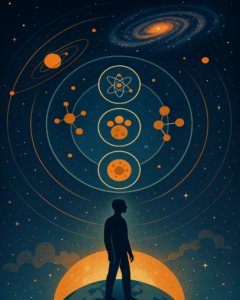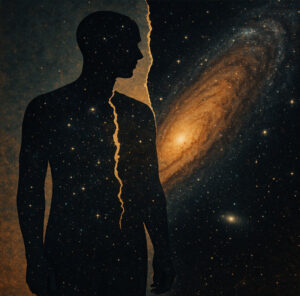

“Life — as we know it — is a flow of events manifested in place and time.”
Simple words that many of humanity’s pioneering minds have repeated throughout history, yet
rarely fully comprehended by individuals. There are several reasons behind our limited ability to
deeply understand this fact.
First, we are completely submerged in this continuous and overwhelming process, with almost no
chance to step outside of it and observe what is truly happening. Secondly, it requires a certain
skill — or perhaps a talent — to see beyond the walls of our senses and minds.
The more I contemplate this statement, the more I discover deeper meanings and fruitful insights
within it. The obvious truth it carries is that we are small, while the whole surrounds us, affects us,
and leads us — often while we have little understanding of what is happening or why.
It reminds me of the famous spiritual analogy of a flowing river: drops of water continuously
jumping up and down according to physical laws, unaware of what is happening or why things
occur as they do. Then, occasionally, certain drops are carried to the shore, leaving the flowing
river behind.
Our subjective vision is limited, largely because we see matters as though we are the centre of the
universe. We see life in the same way a water drop sees the river. The drop does not know the
destination, does not know why the speed changes, why the journey suddenly becomes rough, or
why the river slows down again.
Even when such thoughts cross the mind, the ego fights them with all its strength. This idea is
dangerous to the ego because it removes it from its imagined throne. And perhaps this is the main
reason we rarely realise the wisdom hidden within this statement.
Modern psychology often focuses on strengthening the personal ego. It promotes a comforting,
“feel-better” sentiment, encouraging the belief that a person has the power to create the life they
desire, and the ability to achieve anything if sufficiently determined.
Perhaps this may be true in certain limited and specific situations, but surely it is not the greater
pattern we witness in everyday life. How many unexpected events — good or bad — happen
every single day? How many things occur that were never planned, imagined, or even
considered?
Returning to the statement: life is a continuous flow of events, most of whose causes and
purposes remain hidden from us.
Beginning with birth itself — the family into which a child is born, physical characteristics,
advantages and disadvantages, religion or beliefs, environment, education — all accompanied by
sudden situations, life-altering events, and impressions gathered through experience, which
together shape personality and character.
A flow of events manifested in place and time.
The image it gives is that of a wheel, endlessly rotating, carrying everything within its movement.
The statement is clearly telling us that we are — grammatically speaking — objects under the
control of the verbs.
What does this teach us?
We need to recognise our true position. Realising this fact alone would be a great step forward.
Human beings would become more humble and develop kinder hearts — more forgiving and more tolerant of others — once they understand that we do not truly choose many of the things that
shape who we are.
Then the words of Jesus Christ and Gautama Buddha would reveal their deeper meaning more
clearly.
Love, kindness, compassion, empathy, and tolerance would begin to flourish among us.
Life- A flow of events