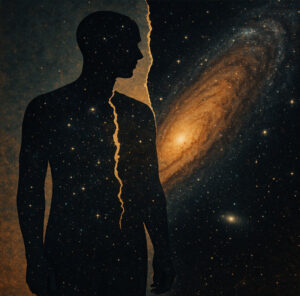



Endless wholes made of countless parts
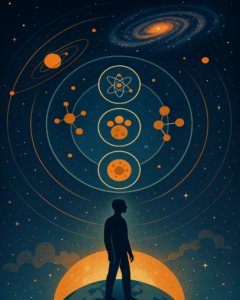
Every entity in the universe is composed of an indefinite number of smaller entities. Atoms inside molecules, molecules inside cells, cells inside organs, organs inside bodies, bodies inside societies, societies inside ecosystems, and so on without a clear beginning or end.
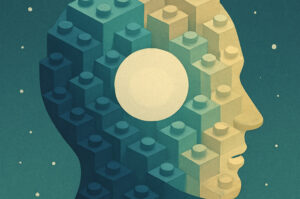
It resembles a huge Lego of sorts, where tiny pieces are set together to form a beautiful picture or a great structure. The difference is that, unlike plastic bricks, all the components in the real world are in continuous movement, each with its own energy, direction, and inner purpose. Every “piece” has its own merits and skills.
This explains the extraordinary sensitivity of the universe, its unbelievable capacity to adapt and transform, and its ability to rejuvenate and rebalance. It also explains the power to grow and branch out into an enormous variety of forms.
Wholes inside wholes inside wholes
When we look closely, nothing exists alone:
-
A cell is a whole made of molecules, but also a part of an organ.
-
An organ is a whole made of cells, but also a part of a body.
-
A human is a whole made of many systems, but also a part of a family, a culture, an ecosystem, a planet.
Every level is both a complete entity and a building block for something larger. This endless nesting creates a universe that is not static but deeply layered. Each layer influences the others. A change in a cell can affect a whole body. A shift in human collective behavior can affect entire ecosystems and the climate.
In my previous article, I spoke about the spiritual insight “All is one.” Here, we see another aspect of that: The One expresses itself as countless wholes made of countless parts, endlessly.
A Lego that keeps rearranging itself
The Lego metaphor helps us imagine how things are built, but we must add one crucial detail: In the real universe, the pieces are alive. They move, interact, learn, and reorganize themselves all the time.
-
Cells repair damage and renew tissues.
-
Ecosystems adjust to changes in climate or species balance.
-
Human societies change their structures, values, and technologies.
It is as if we are inside a self-rearranging Lego set: the pieces are never completely fixed, and the final picture is never finished. This is why the universe is so:
-
Sensitive – because even small movements in the tiny pieces can be felt at larger scales
-
Adaptive – because the arrangement can change to respond to new conditions
-
Creative – because new combinations are always possible
-
Ever-changing and growing
Sensitivity and adaptation: how the universe “feels” and responds
This simple fact—that every entity is made of countless smaller entities—gives the universe some of its most striking features. When everything is composed of smaller living entities, the whole becomes extremely sensitive.
Think of your own body:
-
A small cut in your finger is immediately noticed by your whole system.
-
A tiny virus spreading in a few cells can trigger a full-body immune response.
The same principle appears at larger levels:
-
A small change in temperature can alter an entire ecosystem.
-
A small innovation or idea can transform a whole culture.
This structure of “wholes made of wholes” allows the universe to receive subtle signals and respond in complex ways. Adaptation is not a miracle added from outside; it is a natural result of countless small entities constantly interacting and adjusting to each other.
Rejuvenation, balance, and self-repair
Because everything is built from smaller dynamic parts, rejuvenation and balance become easier to obtain.
-
Old cells die; new cells are born.
-
Forests burn, then regenerate with fresh growth.
-
Societies go through crises and then reorganize with new structures and values.
The universe is not a rigid machine where one broken piece stops everything. It is more like a living organism that can:
-
Replace parts
-
Re-route energy
-
Invent new patterns to keep the larger whole alive
This does not mean there is no loss or suffering. But it means that within the design of the universe, renewal is built in. The ability to “start again” does not belong only to humans; it is a universal principle written in the way reality is composed.
Infinite branching and creative diversity
When you combine many small, active parts in countless ways, you get enormous variety and countless probabilities. From a few basic elements, life creates:
-
Millions of species
-
Countless personal stories
-
Endless cultures, languages, and forms of art
Just like a box of Lego pieces can be used to build a house, a ship, or a castle, the fundamental building blocks of the universe can express themselves as:
-
A tree
-
A star
-
A child
-
A melody
-
A thought
Each form is temporary, but the creative potential is practically infinite. Growth and branching are not accidents; they are almost inevitable when you have a universe made of living, moving, interacting units.
A quiet conclusion
If “All is one” is the big spiritual picture, then “Everything is made of smaller living entities” is one of the ways this truth expresses itself in detail.
We live in a universe that:
-
Feels through its countless parts
-
Adapts through their interactions
-
Heals and rejuvenates by rearranging them
-
Grows by branching into endless forms and stories
We ourselves are both builders and building blocks in this living Lego. Every thought, every gesture, every decision is a tiny piece placed somewhere in the grand structure.
— S. Hanna