

A paradox is born when two opposing ideas are not only possible, but both stand as truth. Life itself is full of such contradictions—quiet tensions that shape our understanding of who we are. One of the deepest paradoxes is the value of an individual life.
From one angle, a single human life is unique, miraculous, and extraordinary. No one has ever lived your exact story before, and no one will ever repeat it. Every person carries a singular blend of emotions, potential, and purpose. From this angle, life feels sacred—rare, precious, and worthy of celebration.
From another angle, the opposite is equally true. Seen from the perspective of the collective, an individual life is one among billions. People are constantly arriving and departing, flowing through time like waves that appear and dissolve. From this lens, each life is brief, fragile, and almost insignificant compared to the vastness of humanity and the universe.
Both views are true at once.
Life is simultaneously a miracle and a moment. It is both deeply personal and universally common. It is priceless—and yet, in the grand scale, a tiny flicker in an endless sequence. Holding these two truths together gives us balance: the first teaches us self-worth and appreciation; the second teaches humility and perspective. To embrace this paradox is to understand life more fully—to honor the miracle of our existence while accepting our small, humble place in the larger story.
Furthermore, a scientific perspective supports the first angle, and the paradox deepens. A human being is not just a life story or a social identity—we are an enormous constellation of particles, a temporary gathering of protons, neutrons, electrons, and sub-atomic phenomena, all suspended in space and time. What appears to our senses as a solid, coherent body is, in reality, a dynamic field of energy and matter continuously interacting with the universe.
Out of this cosmic dance emerges something astonishing: intelligence, consciousness, emotion, intention. The structure that holds it all together is guided by an accumulated, ancient life-force encoded in what we call DNA. To our limited minds, DNA appears as a sequence of chemical instructions, a set of genes that determine how we grow and function. But on a deeper level, it represents billions of years of evolution, memory, and adaptation—life learning from itself.
Thus the human being becomes both a biological miracle and a physical phenomenon: a fleeting arrangement of particles—and at the same time, a self-aware, fully functioning living being.
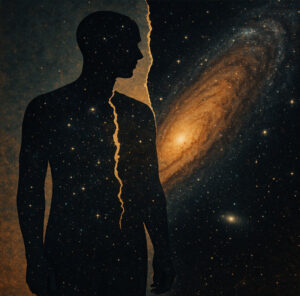
Furthermore, looking at it from the cosmic point of view supports the later angle of the insignificance of an individual human life on Earth. Modern discoveries reveal a universe so vast that our minds can barely grasp its scale. We now know that Earth occupies a tiny, almost invisible corner of a single galaxy—one among hundreds of billions. And in each of those galaxies, the number of stars exceeds the number of grains of sand on all the beaches of our planet.
We are not the center of the universe, and the universe was not created solely for our sake. Our entire existence unfolds on a small, fragile rock orbiting an ordinary star, lost in a cosmic ocean so deep and immense that imagination fails. And yet we live, love, think, create, and search for meaning within this breathtaking vastness.
This cosmic perspective adds another layer to the paradox of life. It reminds us that our significance is not absolute. Meaning changes with scale. The closer we look, the more miraculous the individual appears; the farther we step back, the smaller and more temporary we seem.
All I am trying to say is: relativity is the only solution for the mind to understand such a paradox. Only by shifting our perspective do we discover that truth is never one-dimensional—it is the harmony of opposing angles.